Parallel Time
An essay about Palestine at the NYFF63, on films by Kamal Aljafari, Basma Al-Sharif, and Sepideh Farsi (with Fatma Hassouna), for Film Comment
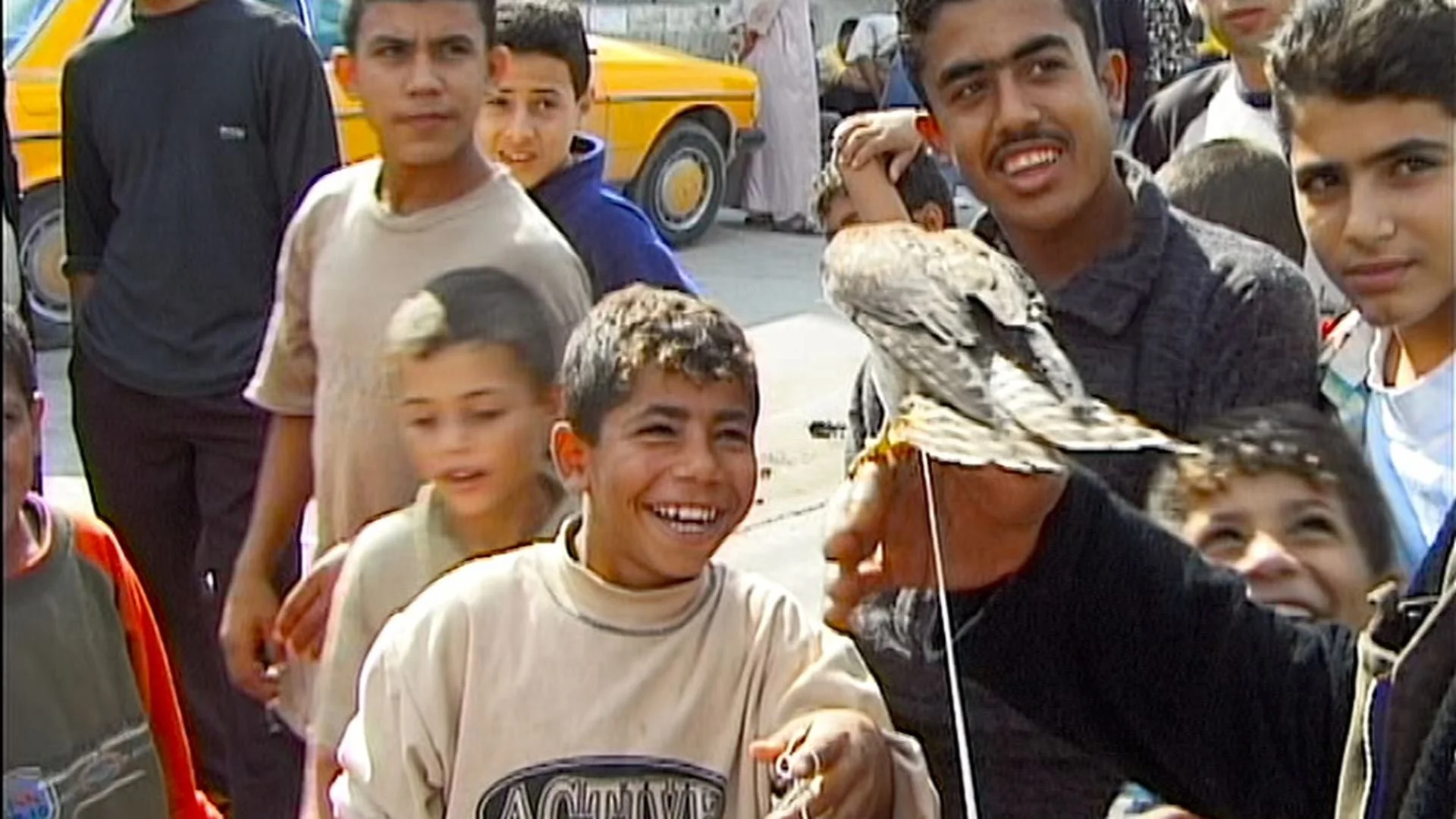
With Hasan in Gaza (Kamal Aljafari, 2025)
“Our time does not proceed on the axis of past and present and future,” wrote the Palestinian political prisoner and novelist Walid Daqqa, nearly 20 years into what would become a life sentence. Daqqa poignantly contrasted the “parallel time” of prison, stretching out indefinitely though never moving forward, with the chronological time outside; yet he understood well that for Palestinians, prison does not end at the cell doors. Later, reflecting on his young daughter’s intuitive understanding of his condition, Daqqa would define prison as a “place without a door.” It’s a phrase that distills much about Palestinian existence under Israeli occupation, particularly, though not only, for those holding onto life in the besieged rubble of Gaza today.
[…] Much of With Hasan in Gaza’s pathos lies in our anachronistic encounter with Gaza’s once-vibrant streets and souks, where smiling children play and fresh vegetables abound. But the rubble, subjugation, and poverty wrought by Israeli occupation are here too; With Hasan cannot escape from Daqqa’s prison, which is both its subject and the prism through which we see Gaza. Aljafari’s first images are of the Israeli military infrastructure through which he passes to enter Gaza; zooming in on an unattended checkpoint, it is as if he seizes the role of the watcher only to exorcise the surveillant gaze. From here on, Aljafari gives us an intimate record of two days and two nights in Gaza, with his friend and guide Hasan Elboubou and himself serving as our companions.
Rarely in cinema is Gaza granted the care of close, tender observation that seeks to know the place from the perspective of a neighbor and friend rather than a journalist or emergency worker. (Important exceptions include Abdel Salam Shehada’s wistful 2008 documentary To My Father and Michel Khleifi’s wondrous 1995 drama Tale of the Three Jewels, the first narrative feature shot entirely in Gaza.) With Hasan is poignant not only because it depicts Gaza before its annihilation, but because Aljafari explores its lifeworlds with a loving curiosity that has nothing to do with saving it or speaking on its behalf. His camera is tactile and active; we feel we are running our hands along the walls of narrow alleyways, idling in a café watching men play cards, or sitting in the passenger seat of a car and gazing out its window.
[…] Basma al-Sharif’s 21-minute experimental short Morning Circle, featured in the NYFF’s Currents program, takes place not in Gaza but amid the reverberations of genocides past and ongoing, in Berlin. (The director was raised in Gaza, the U.S., and France, and now lives in Germany.) Her film is about parenting as an immigrant in a country that sets a dehumanizing standard of assimilation as the cost of its hospitality—or rather, about the dignity to be found in refusing that price. Set during a single morning, its loose narrative is structured around a tense exchange between Herr Abrahamyan (Panos Aprahamian) and an off-screen German bureaucrat who interrogates him, apparently within his own apartment, about his “attachment to our way of life here.” Abrahamyan attests, among other things, that he speaks Arabic but is not Muslim; his Armenian-Arab identity summons a plurality of displacements and attachments opaque to systems of population management. But al-Sharif is not concerned with exposing how the bureaucrat’s questions (“Would you like to go back?”) rest on impossible binaries; Abrahamyan balks at them, coolly smokes his cigarette, and walks away to wake his young son Adnan (Mohammad Ali).
[…] The recurrent techniques employed by al-Sharif—echoes, superimpositions, irruptions—here evoke Edward Said’s celebration of the exile’s contrapuntal vision, their “awareness of simultaneous dimensions.” Scenes of Abrahamyan caring for Adnan, meanwhile, remind us of what it is to build family amid a genocide that has killed, injured, or orphaned countless thousands upon thousands of children (and for which casualty counts of “women and children,” however well-intended, are an affront to the tenderness of Palestinian men). Here is one kaleidoscopic view of what it means for Gaza to resonate within us, wherever we live.
I think of a photo by Hassouna, of a concrete wall blasted open; sunlight streams in from the hole, and through it, we see two cars parked under a horizon of sea and sky. Is it an image of ruination or possibility? If prison is a place without a door, these three films, distinct as they are, pry open apertures into a parallel time and space, from which we must make sense of Gaza’s horizon as intimately tied to our own.
This article appeared in the October 3, 2025 edition of The Film Comment Letter, our free weekly newsletter featuring original film criticism and writing. Sign up for the Letter here.